← All episodes
Episode 123 · Learning & Memory
Why Curiosity Makes Memory Stick
Memory improves when the brain knows why this exact information is worth keeping.
The Science
- Curiosity acts like a tag, telling attention and memory systems that a detail might matter later.
- Turning material into a question changes reading from soaking to hunting, which leaves stronger tracks.
- Testing yourself without looking rebuilds memory under pressure, and a little difficulty is the signal it is working.
The Protocol
- Turn the material into a question before you read.
- Connect the idea to a friend, game, song, mistake, or goal.
- Test yourself without looking, so retrieval becomes the training repetition.
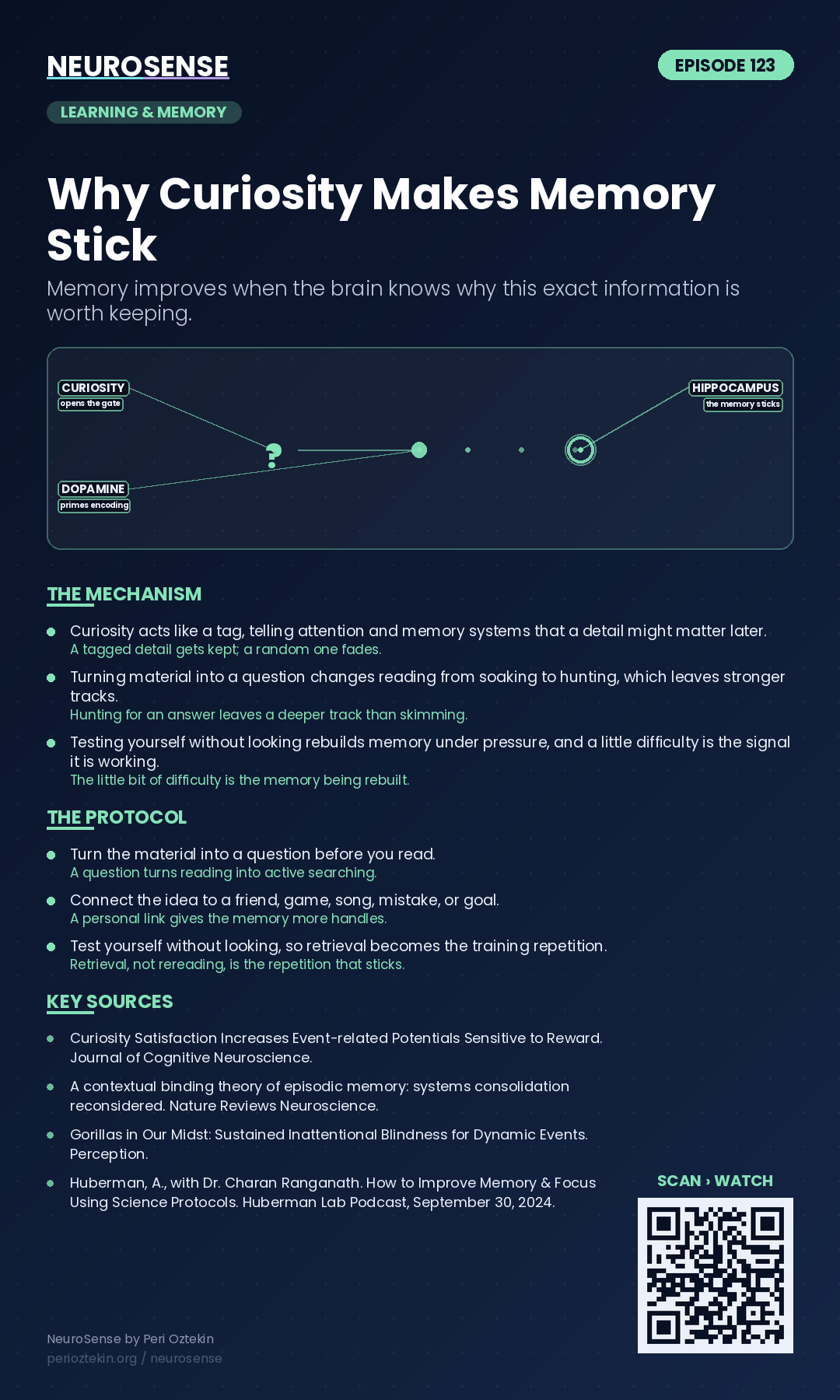
One-page summary
Right-click → Save As to download. Or scan the QR code in the corner to come back here from print.
The science beat (5-sec loop)
Sources
- Curiosity Satisfaction Increases Event-related Potentials Sensitive to Reward. Journal of Cognitive Neuroscience.
- A contextual binding theory of episodic memory: systems consolidation reconsidered. Nature Reviews Neuroscience.
- Gorillas in Our Midst: Sustained Inattentional Blindness for Dynamic Events. Perception.
- Huberman, A., with Dr. Charan Ranganath. How to Improve Memory & Focus Using Science Protocols. Huberman Lab Podcast, September 30, 2024.
Educational content only. Not medical advice.
Also on Instagram: @neurosensebrain
← Back to all episodes