← All episodes
Episode 11 · How the Brain Works
Your Brain Is a Biological Battery
Move just 1 in 100,000 ions across the membrane and you generate -70 mV. The resting potential is built on the tiniest possible imbalance.
The Science
- Hodgkin & Katz (J Physiol, 1949): the resting membrane potential of a neuron arises from differential ion permeability across the membrane. At rest, the membrane is most permeable to K+, which leaks out down its concentration gradient, leaving the interior slightly negative at approximately -70 mV.
- The voltage difference is generated by a tiny charge imbalance: only about 1 in 100,000 ions need to move across the membrane to produce the resting voltage. The bulk concentrations on each side are essentially unchanged.
- Goldman (J Gen Physiol, 1943): the resting potential is quantitatively predicted by the Goldman-Hodgkin-Katz equation, which integrates the permeabilities and concentration gradients of Na+, K+, and Cl-. Resting potential is a permeability-weighted average of the equilibrium potentials for each ion.
- Different neuron types have different resting potentials (-40 to -90 mV) because they express different mixes of leak channels. The resting state is not a single number but a tuned parameter that shapes excitability.
The Protocol
- Potassium-rich foods (bananas, leafy greens, beans, potatoes), K+ is the dominant ion at rest.
- Magnesium (pumpkin seeds, spinach, almonds) supports the ATPase that maintains the gradient.
- Hydration matters, every ion concentration is per liter of water.
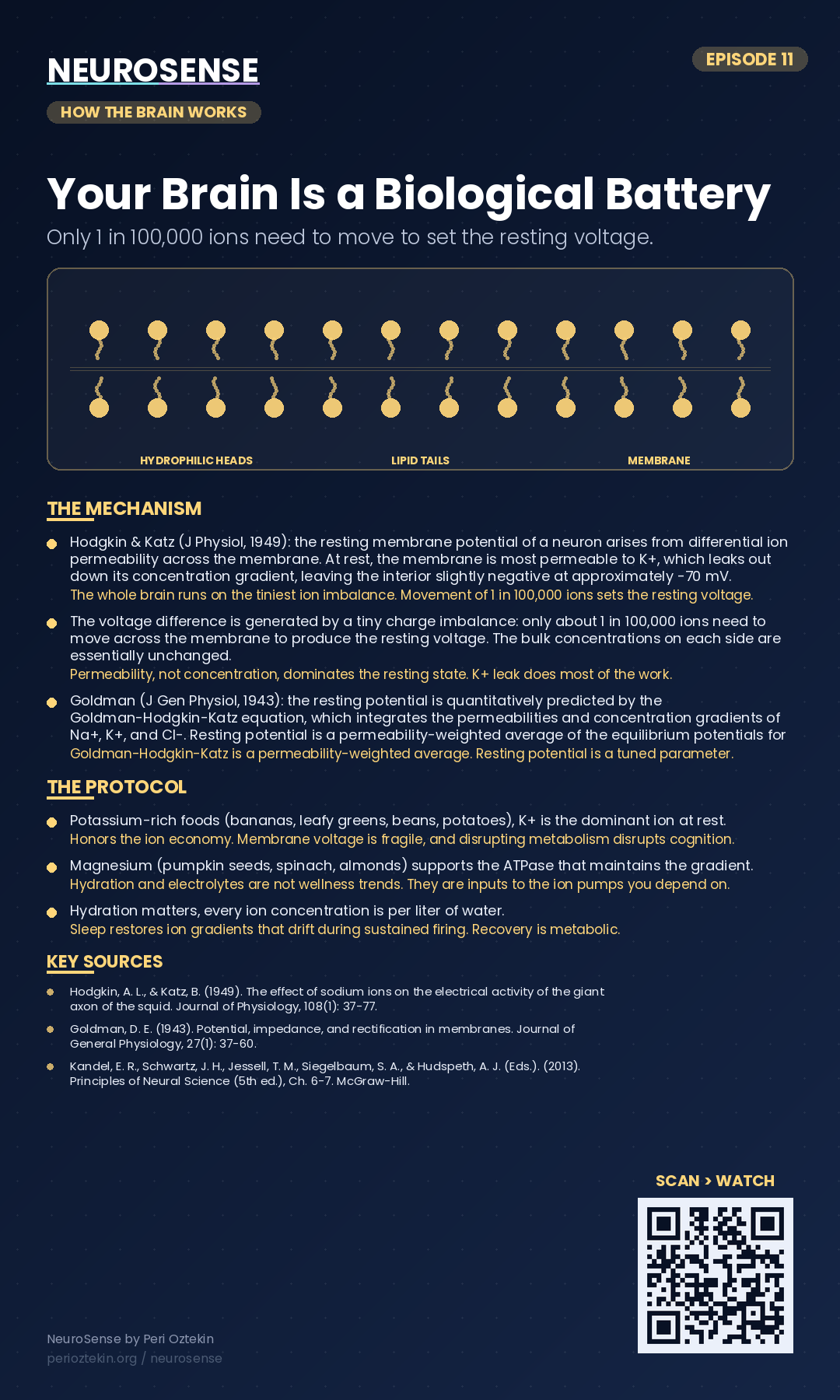
One-page summary
Right-click → Save As to download. Or scan the QR code in the corner to come back here from print.
The science beat (5-sec loop)
Sources
- Hodgkin, A. L., & Katz, B. (1949). The effect of sodium ions on the electrical activity of the giant axon of the squid. Journal of Physiology, 108(1): 37-77.
- Goldman, D. E. (1943). Potential, impedance, and rectification in membranes. Journal of General Physiology, 27(1): 37-60.
- Kandel, E. R., Schwartz, J. H., Jessell, T. M., Siegelbaum, S. A., & Hudspeth, A. J. (Eds.). (2013). Principles of Neural Science (5th ed.), Ch. 6-7. McGraw-Hill.
Educational content only. Not medical advice.
Also on Instagram: @neurosensebrain
← Back to all episodes