← All episodes
Episode 108 · How the Brain Works
The Difference Between Tired and Actually Weak
You feel wiped out and say you are weak. But tired and weak are not the same thing. One is a feeling. The other is your muscles actually failing to do the work.
The Science
- Gilhus & Verschuuren (2015, Lancet Neurol): neuromuscular disease produces true weakness, a measurable loss of force, distinct from the subjective sense of fatigue.
- In myasthenia gravis the weakness is characteristically fatigable and fluctuating, and frequently begins with eye muscles.
- Distinguishing objective weakness from generalized tiredness is a key first step clinicians use to point toward the right diagnosis.
The Protocol
- Separate the feeling of fatigue from an actual loss of strength.
- Note whether rest and sleep reliably restore the ability.
- Flag weakness that worsens with use, fluctuates, or starts in the eyes.
- Bring that specific pattern to a clinician.
One-page summary
Right-click → Save As to download. Or scan the QR code in the corner to come back here from print.
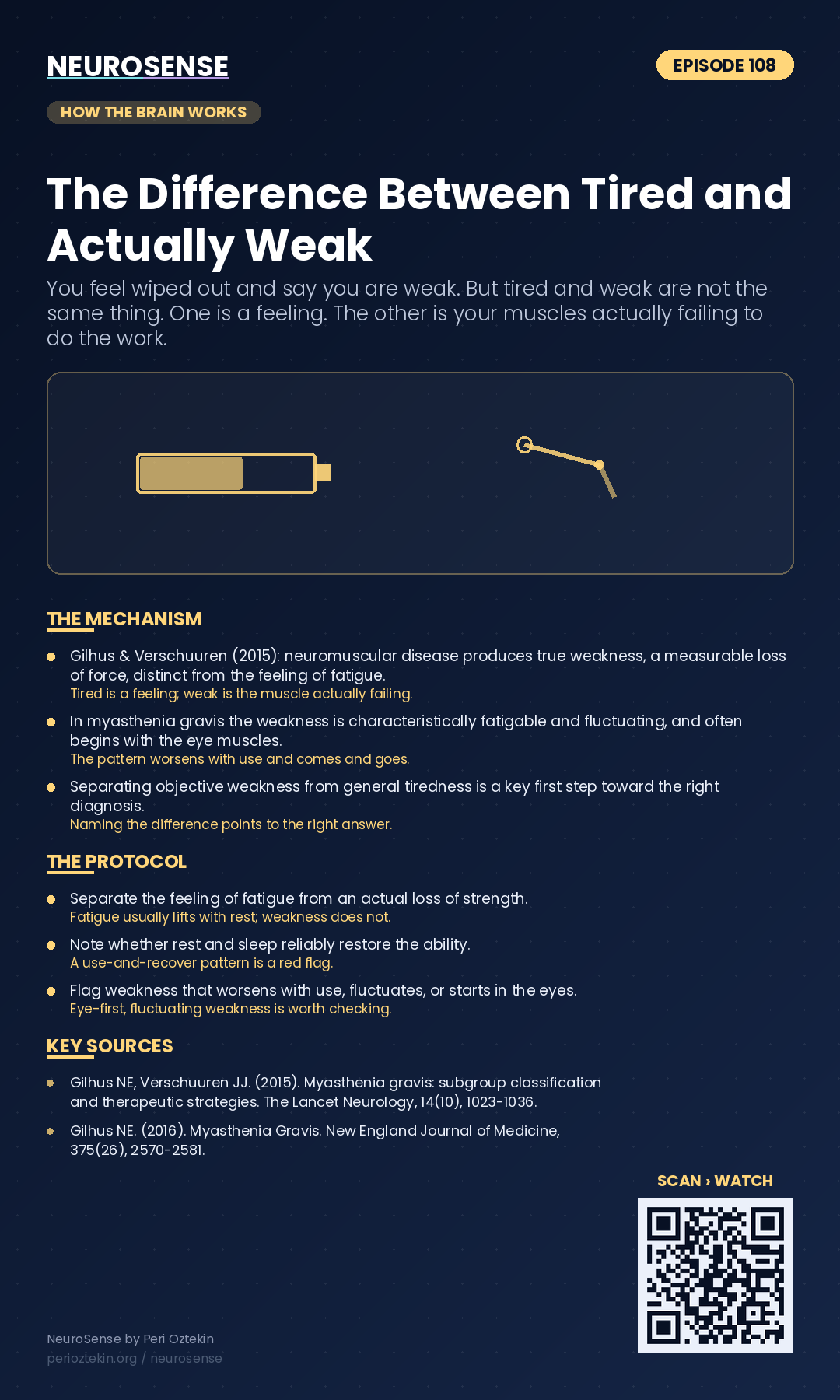
The science beat (5-sec loop)
Sources
- Gilhus NE, Verschuuren JJ. (2015). Myasthenia gravis: subgroup classification and therapeutic strategies. The Lancet Neurology, 14(10), 1023-1036.
- Gilhus NE. (2016). Myasthenia Gravis. New England Journal of Medicine, 375(26), 2570-2581.
Educational content only. Not medical advice.
Also on Instagram: @neurosensebrain
← Back to all episodes