← All episodes
Episode 104 · How the Brain Works
Why the Fix Is Often a Workaround, Not a Cure
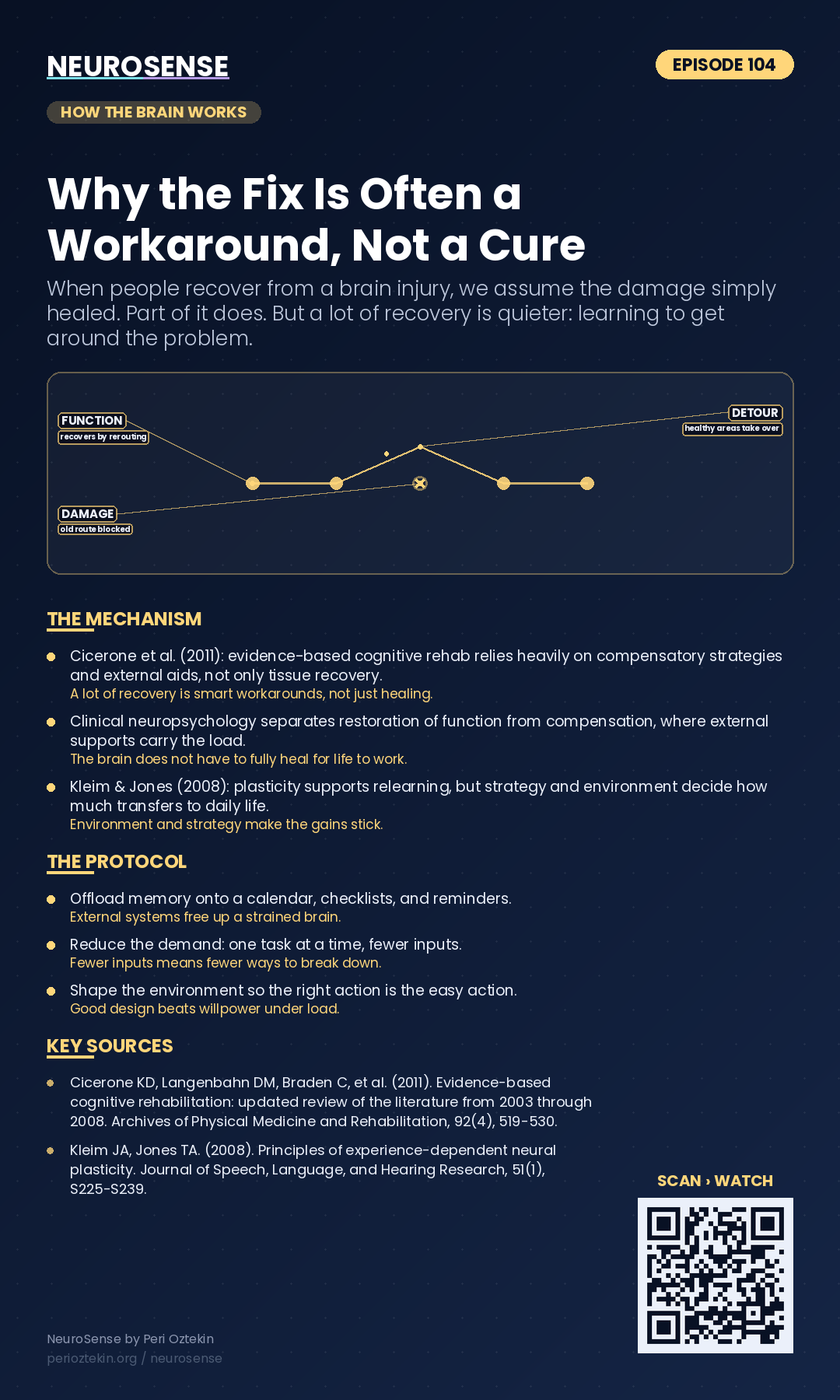
When people recover from a brain injury, we assume the damage simply healed. Part of it does. But a lot of recovery is quieter: learning to get around the problem.
The Science
- Cicerone et al. (2011, Arch Phys Med Rehabil): evidence-based cognitive rehabilitation relies heavily on compensatory strategies, external aids, and restructured environments, not only on tissue recovery.
- Clinical neuropsychology distinguishes restoration of function from compensation, where external supports carry a load the brain no longer handles alone.
- Kleim & Jones (2008, J Speech Lang Hear Res): plasticity supports relearning, but strategy and environment determine how much regained skill transfers to real life.
The Protocol
- Offload memory onto a calendar, checklists, and reminders.
- Reduce the demand: one task at a time, fewer inputs.
- Shape the environment so the right action is the easy action.
- Treat external supports as skill, not as failure.
One-page summary
Right-click → Save As to download. Or scan the QR code in the corner to come back here from print.
The science beat (5-sec loop)
Sources
- Cicerone KD, Langenbahn DM, Braden C, et al. (2011). Evidence-based cognitive rehabilitation: updated review of the literature from 2003 through 2008. Archives of Physical Medicine and Rehabilitation, 92(4), 519-530.
- Kleim JA, Jones TA. (2008). Principles of experience-dependent neural plasticity: implications for rehabilitation after brain damage. Journal of Speech, Language, and Hearing Research, 51(1), S225-S239.
Educational content only. Not medical advice.
Also on Instagram: @neurosensebrain
← Back to all episodes