← All episodes
Episode 103 · How the Brain Works
Why Your Brain Can Rewire Around Damage
You would think that if part of the brain is damaged, that ability is just gone. Often it is not. The brain has a backup plan built into how it is wired.
The Science
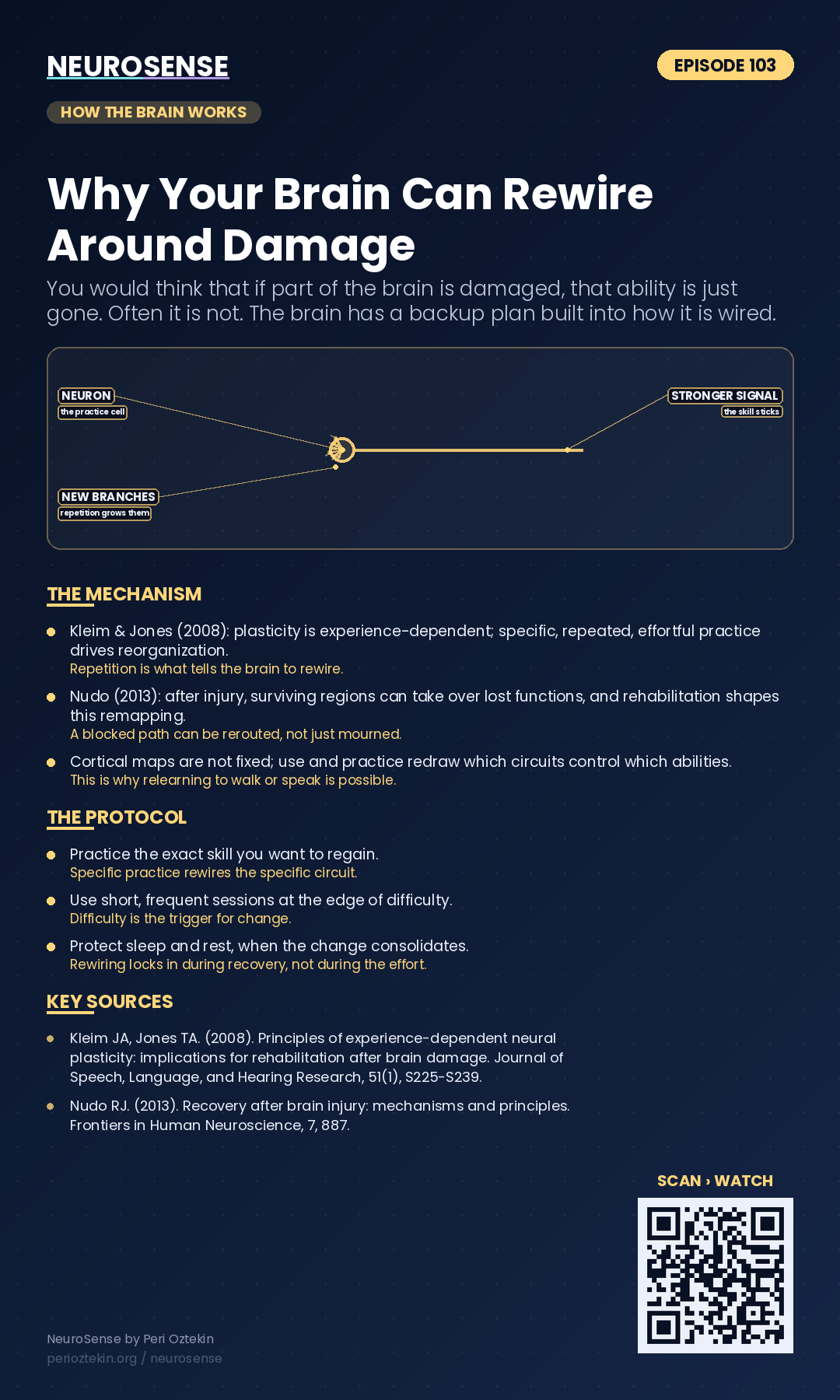
- Kleim & Jones (2008, J Speech Lang Hear Res): neural plasticity is experience-dependent, and specific, repeated, effortful practice is what drives the brain to reorganize.
- Nudo (2013, Front Hum Neurosci): after brain injury, surviving regions can take over lost functions, and rehabilitation shapes this remapping.
- Cortical maps are not fixed; use and practice redraw which circuits control which abilities.
The Protocol
- Practice the exact skill you want to regain, not a vague substitute.
- Use short, frequent sessions rather than rare long ones.
- Work at the edge of difficulty, where change is triggered.
- Protect sleep and rest, when the rewiring consolidates.
One-page summary
Right-click → Save As to download. Or scan the QR code in the corner to come back here from print.
The science beat (5-sec loop)
Sources
- Kleim JA, Jones TA. (2008). Principles of experience-dependent neural plasticity: implications for rehabilitation after brain damage. Journal of Speech, Language, and Hearing Research, 51(1), S225-S239.
- Nudo RJ. (2013). Recovery after brain injury: mechanisms and principles. Frontiers in Human Neuroscience, 7, 887.
Educational content only. Not medical advice.
Also on Instagram: @neurosensebrain
← Back to all episodes