← All episodes
Episode 102 · Sleep, Recovery & the Body
Why You Can't Force Yourself to Sleep Earlier
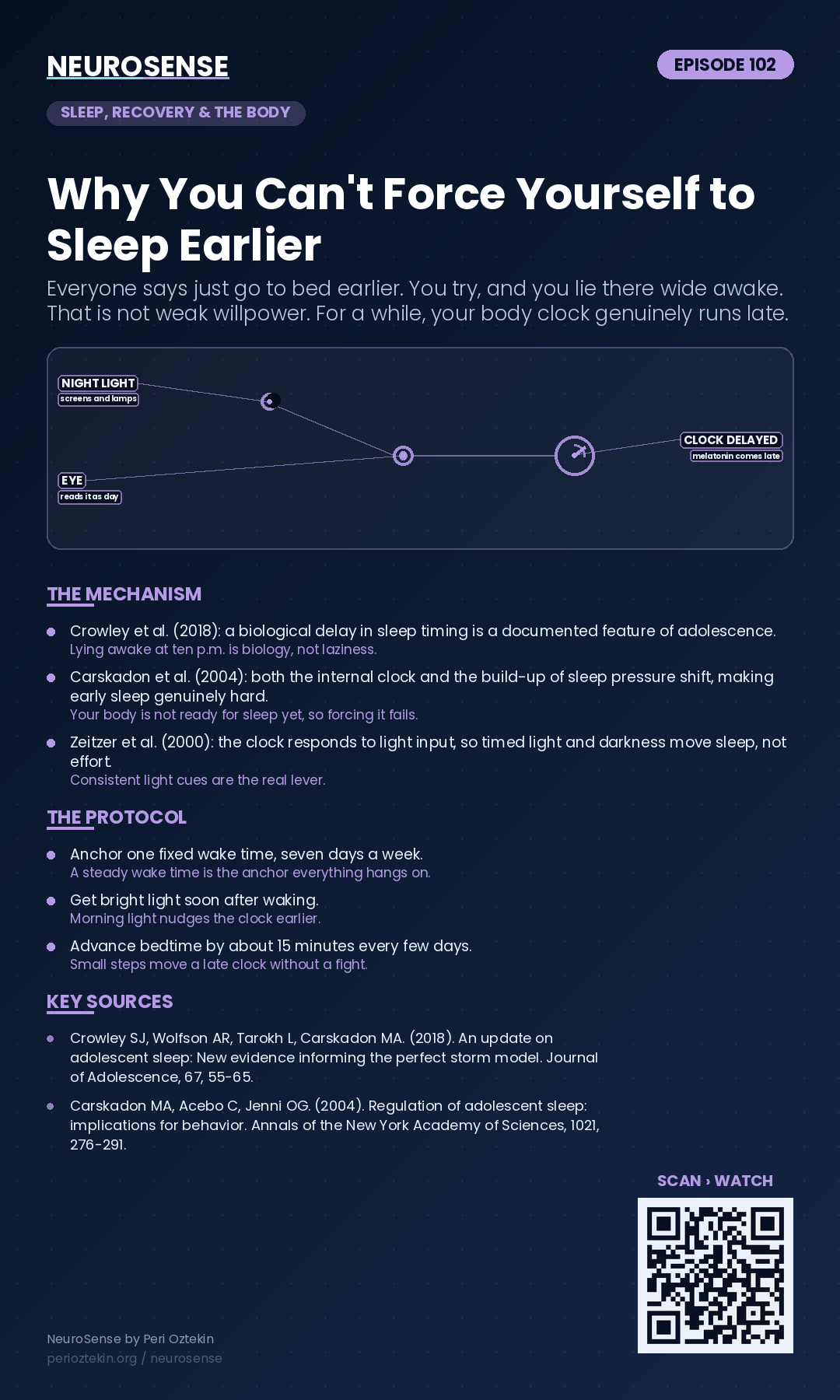
Everyone says just go to bed earlier. You try, and you lie there wide awake. That is not weak willpower. For a while, your body clock genuinely runs late.
The Science
- Crowley, Wolfson, Tarokh & Carskadon (2018, J Adolesc): a biological delay in sleep timing is a well-documented feature of adolescence, driven by changes in both the circadian clock and sleep pressure.
- Carskadon, Acebo & Jenni (2004, Ann N Y Acad Sci): the timing of the internal clock and the build-up of sleep pressure both shift, making early sleep genuinely hard for a delayed clock.
- Zeitzer et al. (2000, J Physiol): the clock responds to light input, so timed light and darkness, not willpower, are what actually move sleep timing.
The Protocol
- Anchor a single fixed wake time first, seven days a week.
- Get bright light soon after waking to pull the clock earlier.
- Reduce bright and blue light in the evening.
- Advance bedtime gradually, about 15 minutes every few days.
One-page summary
Right-click → Save As to download. Or scan the QR code in the corner to come back here from print.
The science beat (5-sec loop)
Sources
- Crowley SJ, Wolfson AR, Tarokh L, Carskadon MA. (2018). An update on adolescent sleep: New evidence informing the perfect storm model. Journal of Adolescence, 67, 55-65.
- Carskadon MA, Acebo C, Jenni OG. (2004). Regulation of adolescent sleep: implications for behavior. Annals of the New York Academy of Sciences, 1021, 276-291.
Educational content only. Not medical advice.
Also on Instagram: @neurosensebrain
← Back to all episodes