← All episodes
Episode 101 · Sleep, Recovery & the Body
Why Morning Light Fixes Your Sleep
You lie down early, close your eyes, and your brain just will not switch off. The fix is not more effort. It is resetting the clock that decides when sleep comes.
The Science
- Zeitzer et al. (2000, J Physiol): the human circadian clock is exquisitely sensitive to light, and evening light both suppresses melatonin and shifts the clock later.
- Czeisler et al. (1989, Science): properly timed bright light can produce strong resetting of the human circadian pacemaker.
- Special retinal cells (melanopsin-containing) feed light information to the brain's master clock, the suprachiasmatic nucleus, which sets the timing of sleep.
The Protocol
- Get outdoor-level light within an hour of waking, ideally 5 to 10 minutes or more.
- Cut bright and blue-heavy light in the last hour before bed.
- Hold a consistent wake time seven days a week.
- Shift your schedule in small steps, not all at once.
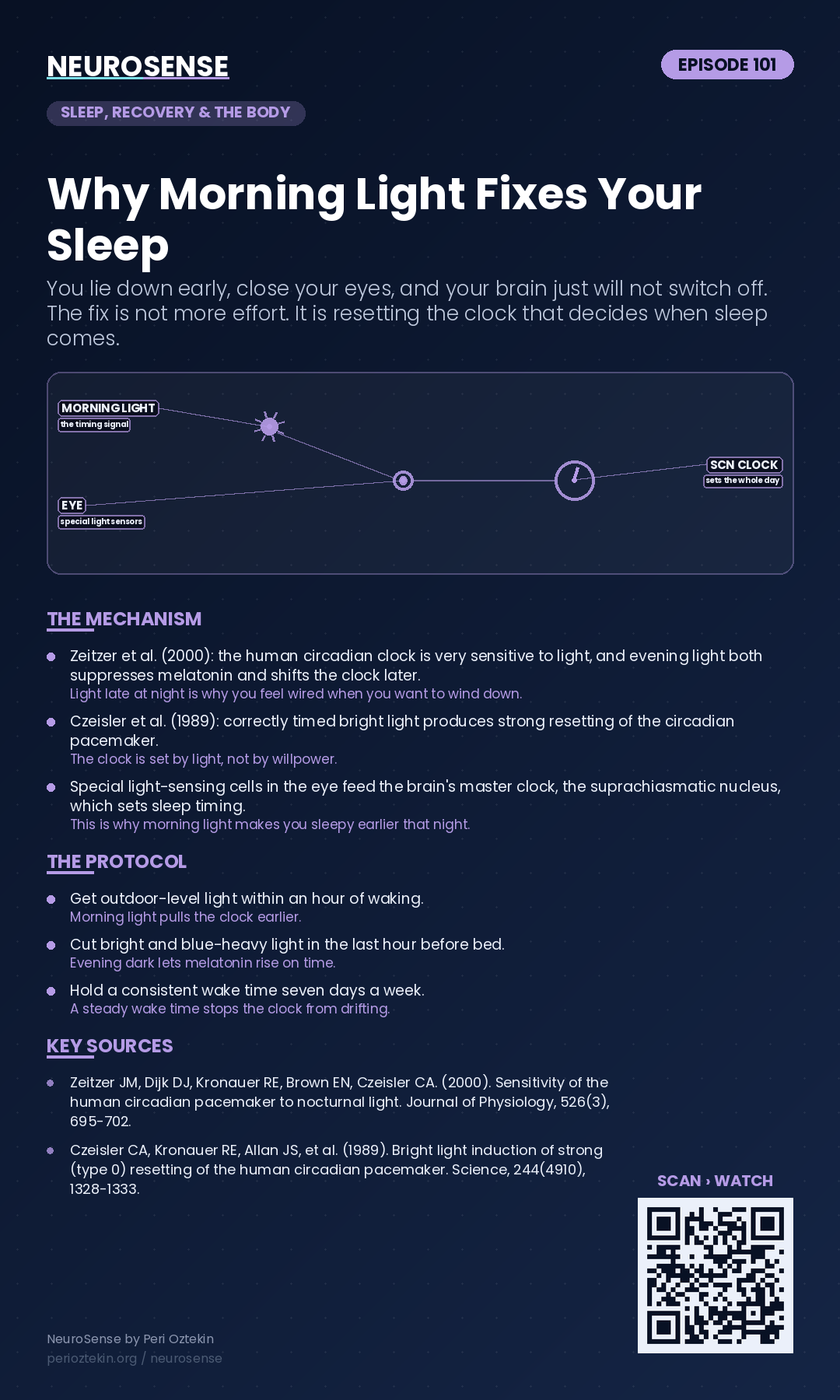
One-page summary
Right-click → Save As to download. Or scan the QR code in the corner to come back here from print.
The science beat (5-sec loop)
Sources
- Zeitzer JM, Dijk DJ, Kronauer RE, Brown EN, Czeisler CA. (2000). Sensitivity of the human circadian pacemaker to nocturnal light: melatonin phase resetting and suppression. Journal of Physiology, 526(3), 695-702.
- Czeisler CA, Kronauer RE, Allan JS, et al. (1989). Bright light induction of strong (type 0) resetting of the human circadian pacemaker. Science, 244(4910), 1328-1333.
Educational content only. Not medical advice.
Also on Instagram: @neurosensebrain
← Back to all episodes