← All episodes
Episode 10 · Sleep, Recovery & the Body
All-Nighters Poison Your Brain
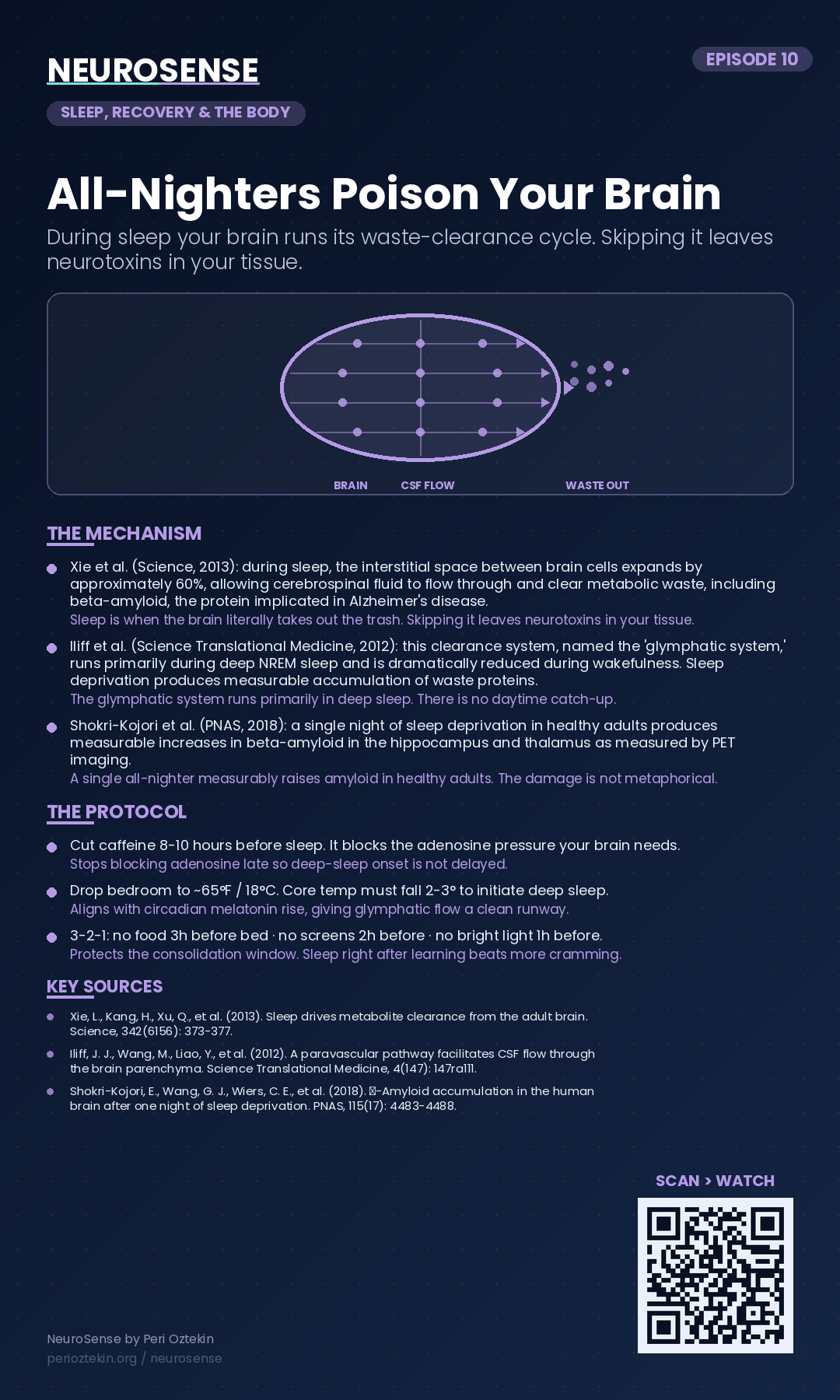
Sleep isn't downtime. It's when the brain runs its cleaning crew, and skipping it leaves neurotoxins in your tissue.
The Science
- Xie et al. (Science, 2013): during sleep, the interstitial space between brain cells expands by approximately 60%, allowing cerebrospinal fluid to flow through and clear metabolic waste, including beta-amyloid, the protein implicated in Alzheimer's disease.
- Iliff et al. (Science Translational Medicine, 2012): this clearance system, named the 'glymphatic system,' runs primarily during deep NREM sleep and is dramatically reduced during wakefulness. Sleep deprivation produces measurable accumulation of waste proteins.
- Shokri-Kojori et al. (PNAS, 2018): a single night of sleep deprivation in healthy adults produces measurable increases in beta-amyloid in the hippocampus and thalamus as measured by PET imaging.
- Walker & Stickgold (Neuron, 2004): sleep also consolidates declarative and procedural memory through hippocampal replay during slow-wave sleep and synaptic-strength rebalancing during REM. All-nighters compromise both clearance and consolidation simultaneously.
The Protocol
- Cut caffeine 8-10 hours before sleep. It blocks the adenosine pressure your brain needs.
- Drop bedroom to ~65°F / 18°C. Core temp must fall 2-3° to initiate deep sleep.
- 3-2-1: no food 3h before bed · no screens 2h before · no bright light 1h before.
One-page summary
Right-click → Save As to download. Or scan the QR code in the corner to come back here from print.
The science beat (5-sec loop)
Sources
- Xie, L., Kang, H., Xu, Q., et al. (2013). Sleep drives metabolite clearance from the adult brain. Science, 342(6156): 373-377.
- Iliff, J. J., Wang, M., Liao, Y., et al. (2012). A paravascular pathway facilitates CSF flow through the brain parenchyma. Science Translational Medicine, 4(147): 147ra111.
- Shokri-Kojori, E., Wang, G. J., Wiers, C. E., et al. (2018). β-Amyloid accumulation in the human brain after one night of sleep deprivation. PNAS, 115(17): 4483-4488.
Educational content only. Not medical advice.
Also on Instagram: @neurosensebrain
← Back to all episodes