← All episodes
Episode 09 · Motivation & Habits
Why You Quit New Habits by Day 4
The 21-day myth is wrong. Habits take ~66 days on average, and the early dropoff is where everyone fails because the neural path isn't paved yet.
The Science
- Lally et al. (European Journal of Social Psychology, 2010): in a behavior-tracking study of 96 participants, the time to reach automaticity for a new daily habit averaged 66 days with a range of 18 to 254 days, depending on behavior complexity. There is no universal '21 days.'
- Hebbian plasticity (Hebb, 1949): 'neurons that fire together wire together.' Each successful repetition strengthens the synaptic pathway via long-term potentiation, gradually moving the behavior from effortful to automatic.
- Graybiel (Annual Review of Neuroscience, 2008): habit formation involves a shift from prefrontal-driven goal-directed control to dorsolateral striatum-driven stimulus-response learning. The transition requires repeated cue-response pairings to engrave the striatal circuit.
- Wood & Neal (Psychological Review, 2007): context cues, not motivation, are the strongest predictor of habit execution. Stable cue + consistent response = automaticity faster than variable contexts.
The Protocol
- Two-minute rule: shrink the habit until starting takes no willpower. 'One push-up' beats 'gym.'
- Habit-stack: anchor to something you already do automatically. 'After coffee → 3 priorities.'
- Track the streak, not the result. Plot the dots. Skip a day, do not skip two.
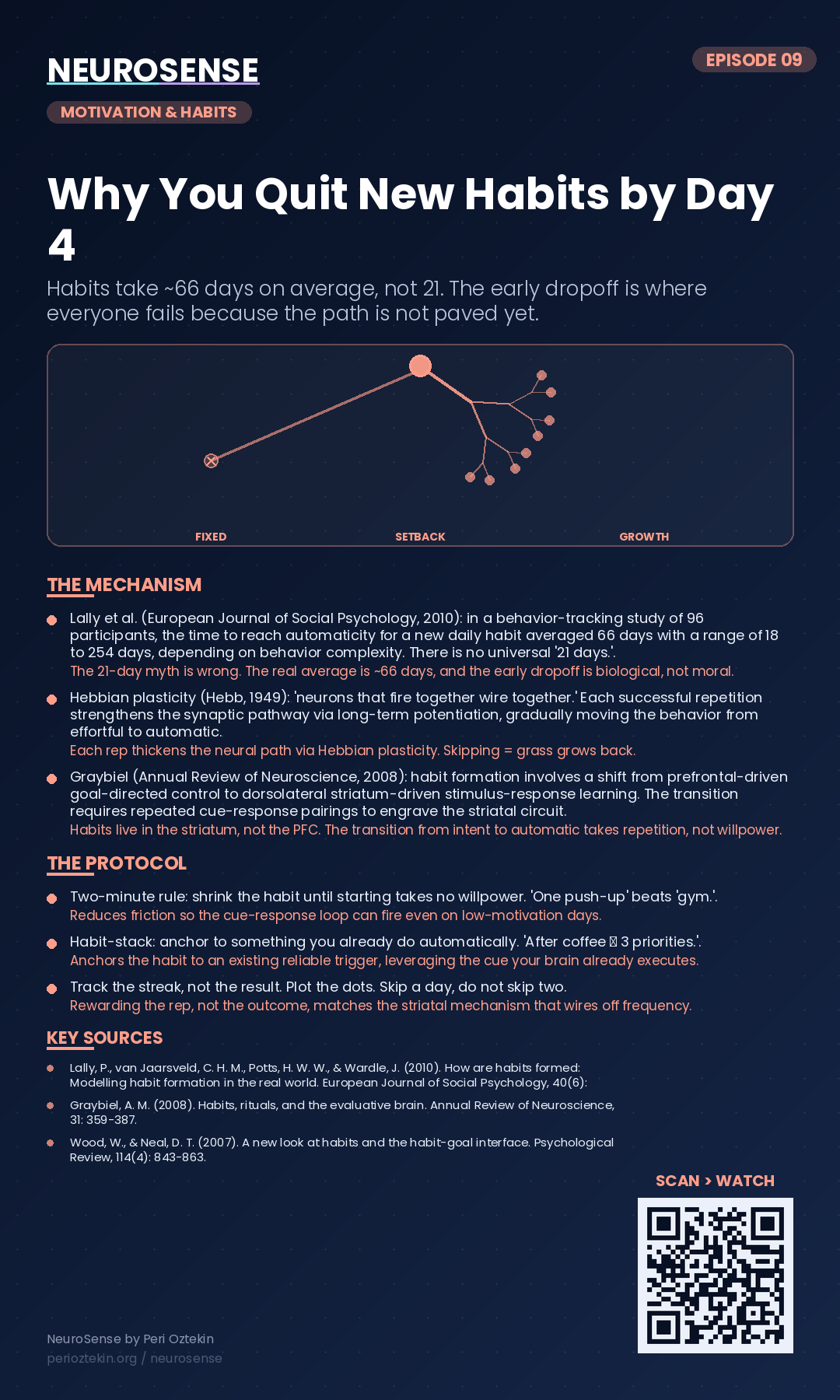
One-page summary
Right-click → Save As to download. Or scan the QR code in the corner to come back here from print.
The science beat (5-sec loop)
Sources
- Lally, P., van Jaarsveld, C. H. M., Potts, H. W. W., & Wardle, J. (2010). How are habits formed: Modelling habit formation in the real world. European Journal of Social Psychology, 40(6): 998-1009.
- Graybiel, A. M. (2008). Habits, rituals, and the evaluative brain. Annual Review of Neuroscience, 31: 359-387.
- Wood, W., & Neal, D. T. (2007). A new look at habits and the habit-goal interface. Psychological Review, 114(4): 843-863.
Educational content only. Not medical advice.
Also on Instagram: @neurosensebrain
← Back to all episodes