← All episodes
Episode 08 · Learning & Memory
Your Brain Learns the Room
Memory stores the place along with the fact. Studying in bed creates a tug-of-war: the same room is signaled for two opposite states.
The Science
- Godden & Baddeley (British Journal of Psychology, 1975): divers who learned word lists underwater recalled significantly more underwater than on land, and vice versa. Environmental context becomes part of the memory trace itself.
- Smith & Vela (Psychonomic Bulletin & Review, 2001): a meta-analysis confirms that context-dependent memory generalizes across modalities (place, sound, mood, and physiological state) and reliably improves recall when contexts match between encoding and retrieval.
- O'Keefe & Dostrovsky (Brain Research, 1971): hippocampal 'place cells' fire selectively when an animal is in specific locations, providing the neural substrate that binds events to where they occurred. Same circuit codes both 'what' and 'where'.
- If a single room is repeatedly paired with two opposite cognitive states (focused study and sleep), the contextual cue becomes ambiguous: the brain cannot use 'bedroom' to cue either state cleanly.
The Protocol
- Pick ONE study anchor that is NOT your bed. Same chair, same desk, same corner of the floor.
- Use the same audio palette there (and only there), multi-sensory anchor.
- Match the test context when you can: same drink, same posture, same room temperature.
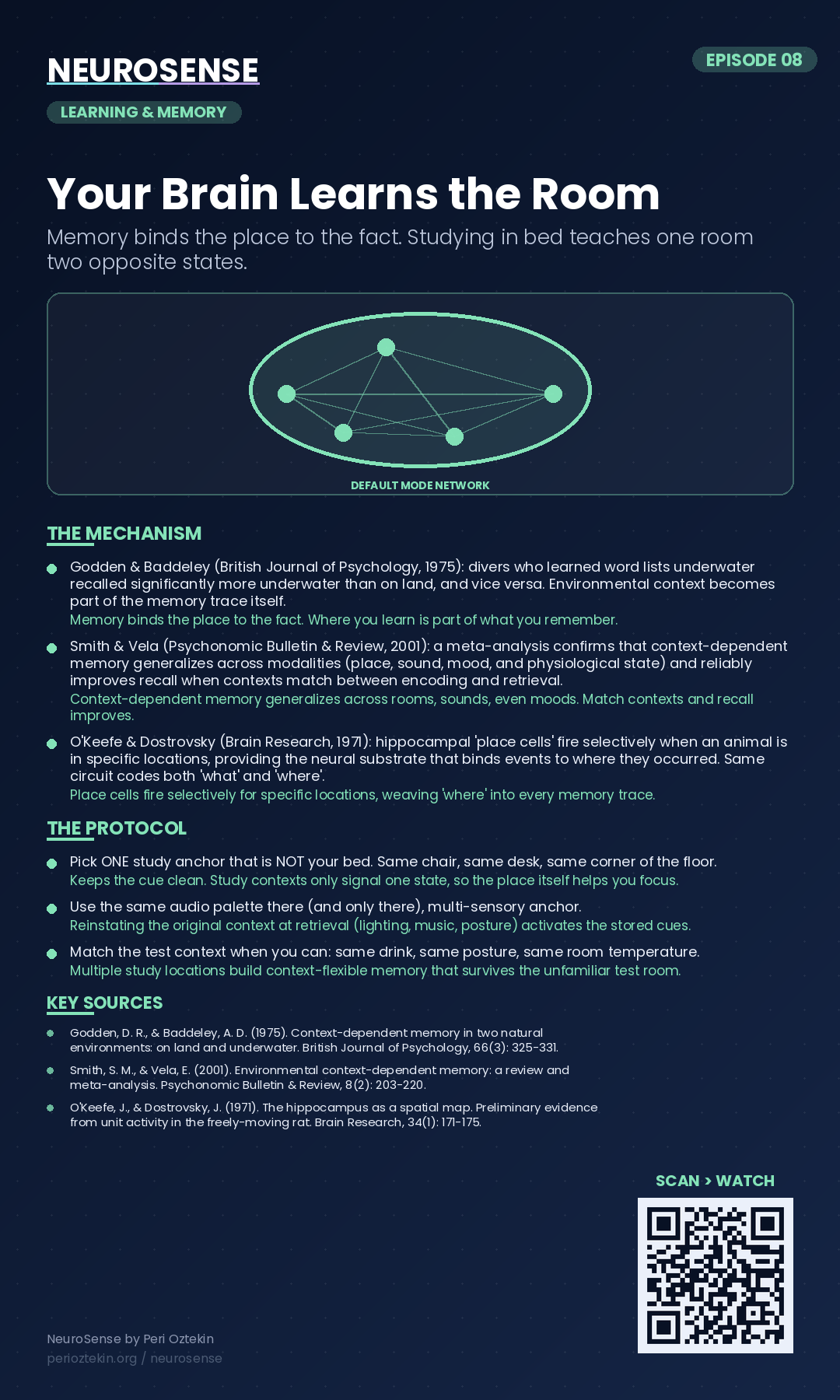
One-page summary
Right-click → Save As to download. Or scan the QR code in the corner to come back here from print.
The science beat (5-sec loop)
Sources
- Godden, D. R., & Baddeley, A. D. (1975). Context-dependent memory in two natural environments: on land and underwater. British Journal of Psychology, 66(3): 325-331.
- Smith, S. M., & Vela, E. (2001). Environmental context-dependent memory: a review and meta-analysis. Psychonomic Bulletin & Review, 8(2): 203-220.
- O'Keefe, J., & Dostrovsky, J. (1971). The hippocampus as a spatial map. Preliminary evidence from unit activity in the freely-moving rat. Brain Research, 34(1): 171-175.
Educational content only. Not medical advice.
Also on Instagram: @neurosensebrain
← Back to all episodes