← All episodes
Episode 07 · The Social Brain
Why Cringe Feels Physical
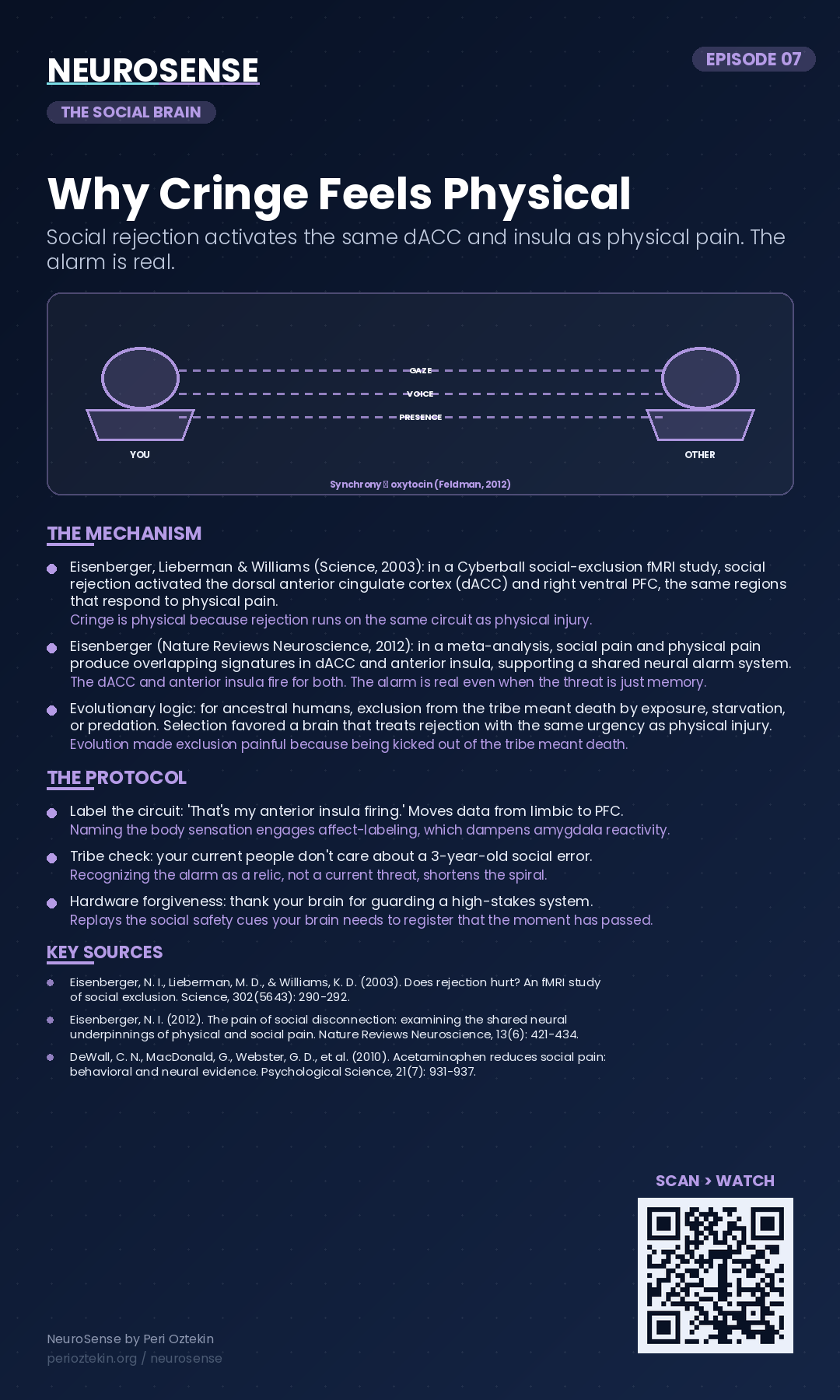
That old embarrassing memory makes you wince for a reason. Social pain and physical pain run on the same neural hardware.
The Science
- Eisenberger, Lieberman & Williams (Science, 2003): in a Cyberball social-exclusion fMRI study, social rejection activated the dorsal anterior cingulate cortex (dACC) and right ventral PFC, the same regions that respond to physical pain.
- Eisenberger (Nature Reviews Neuroscience, 2012): in a meta-analysis, social pain and physical pain produce overlapping signatures in dACC and anterior insula, supporting a shared neural alarm system.
- Evolutionary logic: for ancestral humans, exclusion from the tribe meant death by exposure, starvation, or predation. Selection favored a brain that treats rejection with the same urgency as physical injury.
- DeWall et al. (Psychological Science, 2010): acetaminophen, a physical pain reliever, measurably reduces self-reported social pain and dACC activity during social-exclusion tasks. Same circuit, same pharmacology.
The Protocol
- Label the circuit: 'That's my anterior insula firing.' Moves data from limbic to PFC.
- Tribe check: your current people don't care about a 3-year-old social error.
- Hardware forgiveness: thank your brain for guarding a high-stakes system.
One-page summary
Right-click → Save As to download. Or scan the QR code in the corner to come back here from print.
The science beat (5-sec loop)
Sources
- Eisenberger, N. I., Lieberman, M. D., & Williams, K. D. (2003). Does rejection hurt? An fMRI study of social exclusion. Science, 302(5643): 290-292.
- Eisenberger, N. I. (2012). The pain of social disconnection: examining the shared neural underpinnings of physical and social pain. Nature Reviews Neuroscience, 13(6): 421-434.
- DeWall, C. N., MacDonald, G., Webster, G. D., et al. (2010). Acetaminophen reduces social pain: behavioral and neural evidence. Psychological Science, 21(7): 931-937.
Educational content only. Not medical advice.
Also on Instagram: @neurosensebrain
← Back to all episodes