← All episodes
Episode 06 · Neurodivergence
What If Autism Isn't a Deficit?
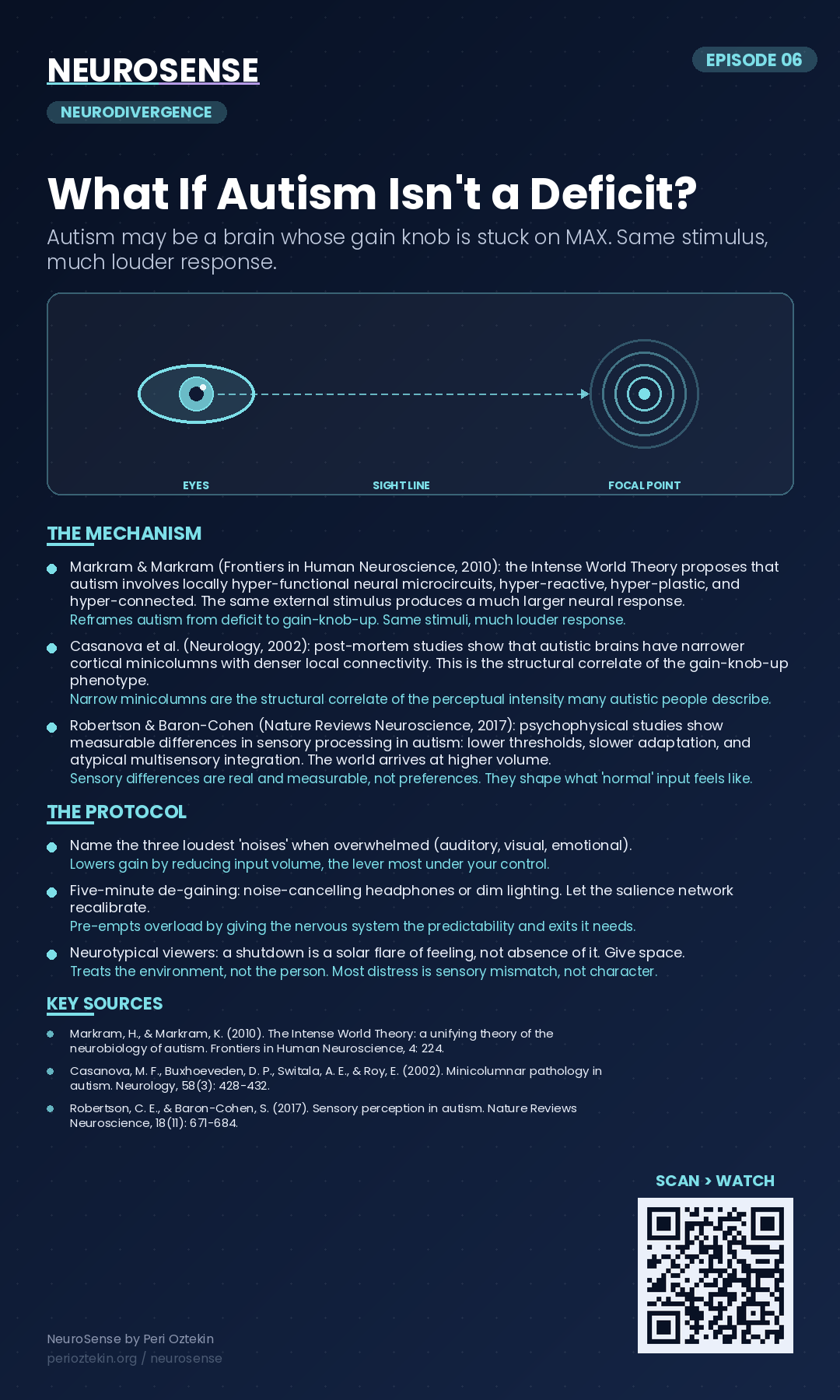
The Intense World Theory reframes autism: not a deficit of feeling, but a brain whose gain knob is stuck on MAX. Same signals, louder response.
The Science
- Markram & Markram (Frontiers in Human Neuroscience, 2010): the Intense World Theory proposes that autism involves locally hyper-functional neural microcircuits, hyper-reactive, hyper-plastic, and hyper-connected. The same external stimulus produces a much larger neural response.
- Casanova et al. (Neurology, 2002): post-mortem studies show that autistic brains have narrower cortical minicolumns with denser local connectivity. This is the structural correlate of the gain-knob-up phenotype.
- Robertson & Baron-Cohen (Nature Reviews Neuroscience, 2017): psychophysical studies show measurable differences in sensory processing in autism: lower thresholds, slower adaptation, and atypical multisensory integration. The world arrives at higher volume.
- The 'shutdown' in a loud classroom is not disengagement. It is system overload: when input exceeds processing bandwidth, the only protective response is to disconnect from the source.
The Protocol
- Name the three loudest 'noises' when overwhelmed (auditory, visual, emotional).
- Five-minute de-gaining: noise-cancelling headphones or dim lighting. Let the salience network recalibrate.
- Neurotypical viewers: a shutdown is a solar flare of feeling, not absence of it. Give space.
One-page summary
Right-click → Save As to download. Or scan the QR code in the corner to come back here from print.
The science beat (5-sec loop)
Sources
- Markram, H., & Markram, K. (2010). The Intense World Theory: a unifying theory of the neurobiology of autism. Frontiers in Human Neuroscience, 4: 224.
- Casanova, M. F., Buxhoeveden, D. P., Switala, A. E., & Roy, E. (2002). Minicolumnar pathology in autism. Neurology, 58(3): 428-432.
- Robertson, C. E., & Baron-Cohen, S. (2017). Sensory perception in autism. Nature Reviews Neuroscience, 18(11): 671-684.
Educational content only. Not medical advice.
Also on Instagram: @neurosensebrain
← Back to all episodes