← All episodes
Episode 05 · Stress & Emotion
Why Your Mind Goes Blank Under Stress
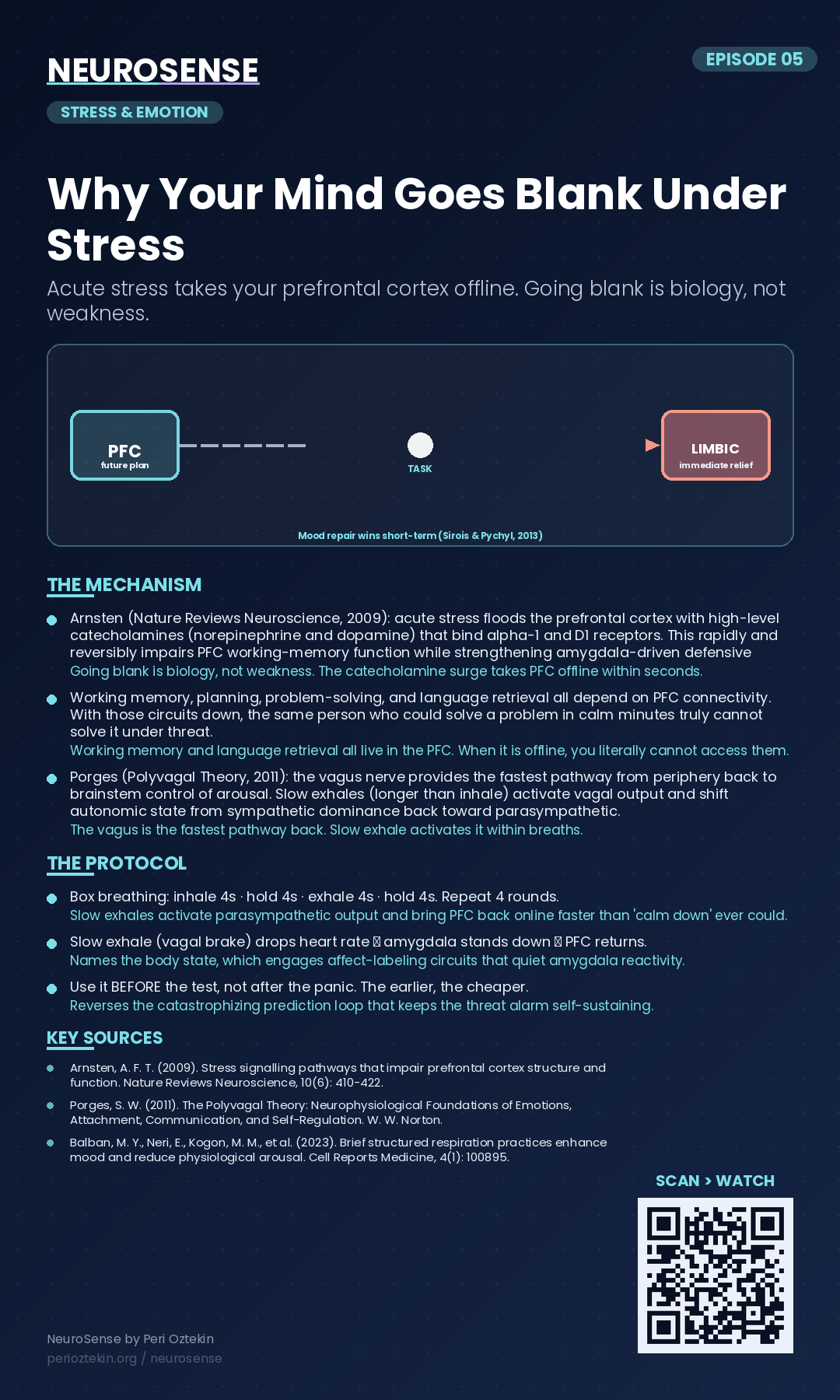
Going blank under stress isn't weakness. The amygdala fire-alarm physically takes your prefrontal cortex offline, and only the parasympathetic system can bring it back fast.
The Science
- Arnsten (Nature Reviews Neuroscience, 2009): acute stress floods the prefrontal cortex with high-level catecholamines (norepinephrine and dopamine) that bind alpha-1 and D1 receptors. This rapidly and reversibly impairs PFC working-memory function while strengthening amygdala-driven defensive responses.
- Working memory, planning, problem-solving, and language retrieval all depend on PFC connectivity. With those circuits down, the same person who could solve a problem in calm minutes truly cannot solve it under threat.
- Porges (Polyvagal Theory, 2011): the vagus nerve provides the fastest pathway from periphery back to brainstem control of arousal. Slow exhales (longer than inhale) activate vagal output and shift autonomic state from sympathetic dominance back toward parasympathetic.
- The 'physiological sigh' (Balban et al., 2023): two short inhales followed by a long exhale is the most efficient single breath pattern for lowering acute arousal in human studies.
The Protocol
- Box breathing: inhale 4s · hold 4s · exhale 4s · hold 4s. Repeat 4 rounds.
- Slow exhale (vagal brake) drops heart rate → amygdala stands down → PFC returns.
- Use it BEFORE the test, not after the panic. The earlier, the cheaper.
One-page summary
Right-click → Save As to download. Or scan the QR code in the corner to come back here from print.
The science beat (5-sec loop)
Sources
- Arnsten, A. F. T. (2009). Stress signalling pathways that impair prefrontal cortex structure and function. Nature Reviews Neuroscience, 10(6): 410-422.
- Porges, S. W. (2011). The Polyvagal Theory: Neurophysiological Foundations of Emotions, Attachment, Communication, and Self-Regulation. W. W. Norton.
- Balban, M. Y., Neri, E., Kogon, M. M., et al. (2023). Brief structured respiration practices enhance mood and reduce physiological arousal. Cell Reports Medicine, 4(1): 100895.
Educational content only. Not medical advice.
Also on Instagram: @neurosensebrain
← Back to all episodes