← All episodes
Episode 04 · Neurodivergence
Why ADHD Brains Can't Start (But Can Hyperfocus)
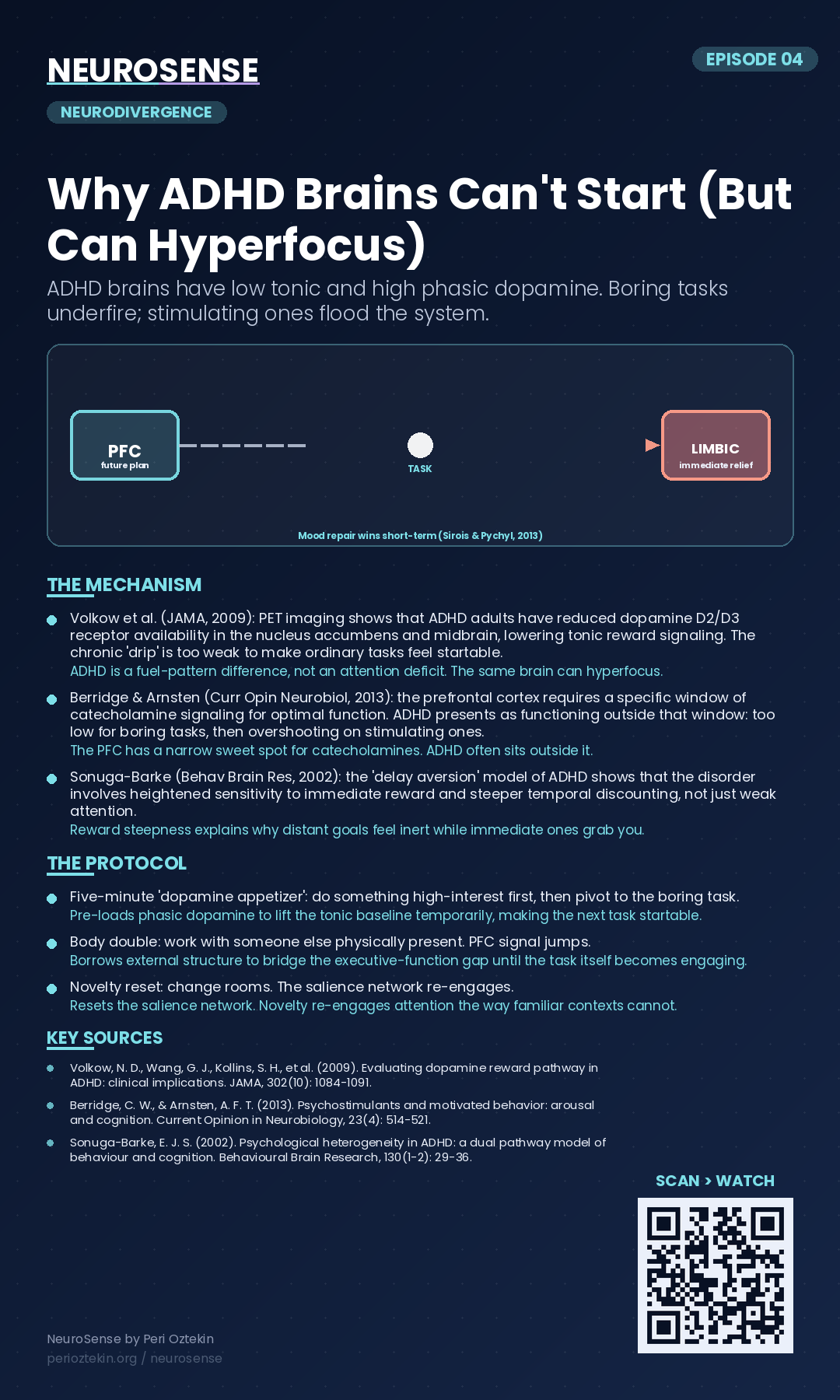
ADHD brains don't lack attention. They have a different dopamine fuel pattern: too low at baseline to start boring tasks, but flooded by anything stimulating.
The Science
- Volkow et al. (JAMA, 2009): PET imaging shows that ADHD adults have reduced dopamine D2/D3 receptor availability in the nucleus accumbens and midbrain, lowering tonic reward signaling. The chronic 'drip' is too weak to make ordinary tasks feel startable.
- Berridge & Arnsten (Curr Opin Neurobiol, 2013): the prefrontal cortex requires a specific window of catecholamine signaling for optimal function. ADHD presents as functioning outside that window: too low for boring tasks, then overshooting on stimulating ones.
- Sonuga-Barke (Behav Brain Res, 2002): the 'delay aversion' model of ADHD shows that the disorder involves heightened sensitivity to immediate reward and steeper temporal discounting, not just weak attention.
- Hyperfocus is the flip-side: when an activity provides high phasic dopamine (games, novel video, intense interest), the same brain locks in for hours. Same hardware, different fuel pattern.
The Protocol
- Five-minute 'dopamine appetizer': do something high-interest first, then pivot to the boring task.
- Body double: work with someone else physically present. PFC signal jumps.
- Novelty reset: change rooms. The salience network re-engages.
One-page summary
Right-click → Save As to download. Or scan the QR code in the corner to come back here from print.
The science beat (5-sec loop)
Sources
- Volkow, N. D., Wang, G. J., Kollins, S. H., et al. (2009). Evaluating dopamine reward pathway in ADHD: clinical implications. JAMA, 302(10): 1084-1091.
- Berridge, C. W., & Arnsten, A. F. T. (2013). Psychostimulants and motivated behavior: arousal and cognition. Current Opinion in Neurobiology, 23(4): 514-521.
- Sonuga-Barke, E. J. S. (2002). Psychological heterogeneity in ADHD: a dual pathway model of behaviour and cognition. Behavioural Brain Research, 130(1-2): 29-36.
Educational content only. Not medical advice.
Also on Instagram: @neurosensebrain
← Back to all episodes