← All episodes
Episode 03 · Focus & Attention
Why Multitasking Is Slowing You Down
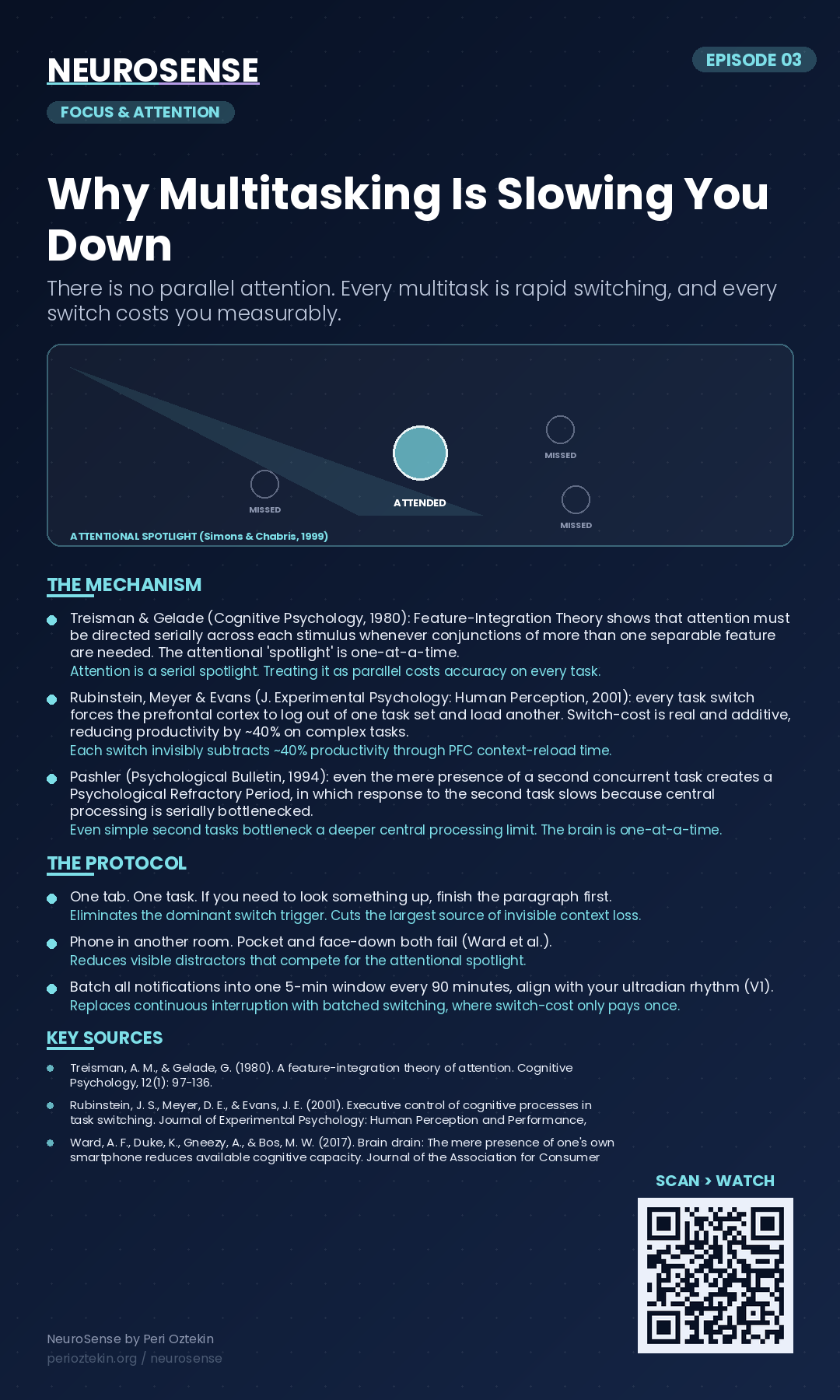
There's no such thing as parallel attention. Every 'multitask' is rapid switching, and every switch costs you measurably.
The Science
- Treisman & Gelade (Cognitive Psychology, 1980): Feature-Integration Theory shows that attention must be directed serially across each stimulus whenever conjunctions of more than one separable feature are needed. The attentional 'spotlight' is one-at-a-time.
- Rubinstein, Meyer & Evans (J. Experimental Psychology: Human Perception, 2001): every task switch forces the prefrontal cortex to log out of one task set and load another. Switch-cost is real and additive, reducing productivity by ~40% on complex tasks.
- Pashler (Psychological Bulletin, 1994): even the mere presence of a second concurrent task creates a Psychological Refractory Period, in which response to the second task slows because central processing is serially bottlenecked.
- Ward et al. (J. Consumer Research, 2017): even the presence of a silenced smartphone in the room measurably reduces available working-memory capacity. Cognitive resources are recruited just to keep the phone in attention's blind spot.
The Protocol
- One tab. One task. If you need to look something up, finish the paragraph first.
- Phone in another room. Pocket and face-down both fail (Ward et al.).
- Batch all notifications into one 5-min window every 90 minutes, align with your ultradian rhythm (V1).
One-page summary
Right-click → Save As to download. Or scan the QR code in the corner to come back here from print.
The science beat (5-sec loop)
Sources
- Treisman, A. M., & Gelade, G. (1980). A feature-integration theory of attention. Cognitive Psychology, 12(1): 97-136.
- Rubinstein, J. S., Meyer, D. E., & Evans, J. E. (2001). Executive control of cognitive processes in task switching. Journal of Experimental Psychology: Human Perception and Performance, 27(4): 763-797.
- Ward, A. F., Duke, K., Gneezy, A., & Bos, M. W. (2017). Brain drain: The mere presence of one's own smartphone reduces available cognitive capacity. Journal of the Association for Consumer Research, 2(2): 140-154.
Educational content only. Not medical advice.
Also on Instagram: @neurosensebrain
← Back to all episodes