← All episodes
Episode 02 · Motivation & Habits
Why TikTok Makes Studying Feel Impossible
TikTok isn't poorly designed for your attention. It's perfectly designed for the dopamine prediction-error system, which is exactly why studying feels impossible afterward.
The Science
- Schultz, Dayan & Montague (Science, 1997): midbrain dopamine neurons (VTA and substantia nigra) fire in proportion to reward prediction error: the difference between expected and received reward. Unpredictable rewards trigger the largest dopamine response.
- Variable-ratio schedules (TikTok, slot machines, social-media feeds) maximize prediction error because each swipe might or might not produce a hit. This is the strongest dopamine reinforcement schedule known.
- Berridge & Robinson (Brain Research Reviews, 1998): dopamine encodes 'wanting' (motivational salience), not 'liking' (hedonic pleasure). The system can drive compulsive seeking without proportional enjoyment.
- Volkow et al. (Mol Psychiatry, 2011): repeated supraphysiological dopamine spikes downregulate striatal D2 receptors. Lower-stimulation activities like reading then feel under-rewarding by comparison.
The Protocol
- Phone → grayscale for one hour before homework. Removes the colour reward.
- Wait 90-120 min after waking for caffeine. Don't blow out receptors first thing.
- Pre-bore your brain: 10 min folding laundry or staring at a wall before a hard task.
One-page summary
Right-click → Save As to download. Or scan the QR code in the corner to come back here from print.
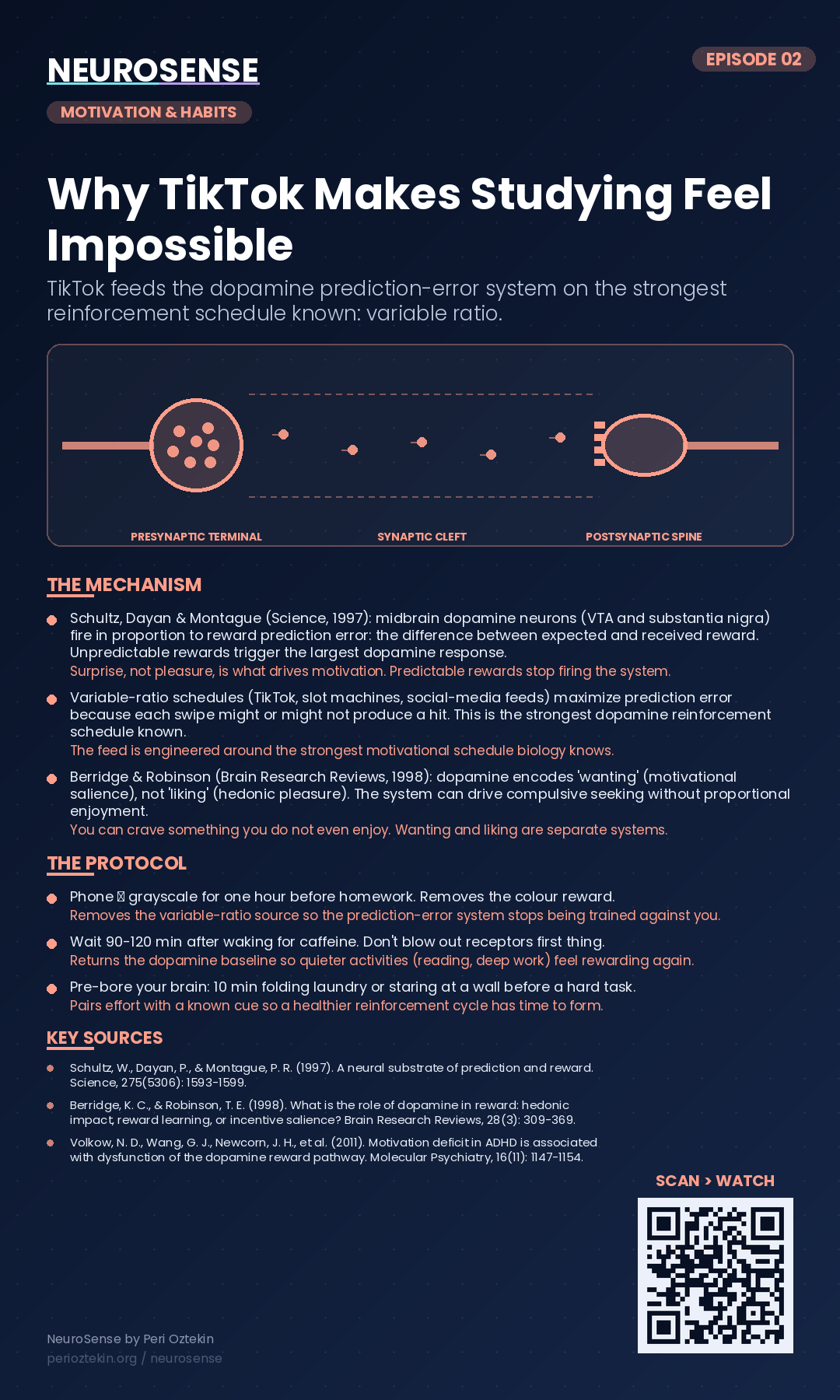
The science beat (5-sec loop)
Sources
- Schultz, W., Dayan, P., & Montague, P. R. (1997). A neural substrate of prediction and reward. Science, 275(5306): 1593-1599.
- Berridge, K. C., & Robinson, T. E. (1998). What is the role of dopamine in reward: hedonic impact, reward learning, or incentive salience? Brain Research Reviews, 28(3): 309-369.
- Volkow, N. D., Wang, G. J., Newcorn, J. H., et al. (2011). Motivation deficit in ADHD is associated with dysfunction of the dopamine reward pathway. Molecular Psychiatry, 16(11): 1147-1154.
Educational content only. Not medical advice.
Also on Instagram: @neurosensebrain
← Back to all episodes