← All episodes
Episode 01 · Focus & Attention
Why Your Last Study Hour Is Wasted
Your brain doesn't run on continuous focus. It runs on 90-minute ultradian cycles, and the hour after each one matters as much as the hour itself.
The Science
- Kleitman (Sleep, 1982): the brain runs on an ultradian 'Basic Rest-Activity Cycle' of roughly 90 minutes of high alertness followed by a 20-minute trough. The drop is not a discipline failure; it is a biological boundary.
- Adenosine builds across each cycle: as neural firing accumulates, ATP breakdown releases adenosine that occupies A1/A2A receptors and dampens cortical excitability. By the end of a 90-min block the signal-to-noise ratio for new learning collapses.
- Tambini, Ketz & Davachi (Neuron, 2010): in the rest window right after studying, the hippocampus replays the neural firing patterns of what was just learned. This offline replay is when the memory actually consolidates.
- Scrolling or new-stimulus seeking during that window hijacks the replay: dopamine spikes from novel input overwrite the consolidation signal.
The Protocol
- Set a 90-minute timer. Phone in another room.
- When it ends, STOP. Don't push 'one more chapter.'
- 20 minutes of low-input rest. Walk, stare, lie down. No phone.
- That rest IS the studying.
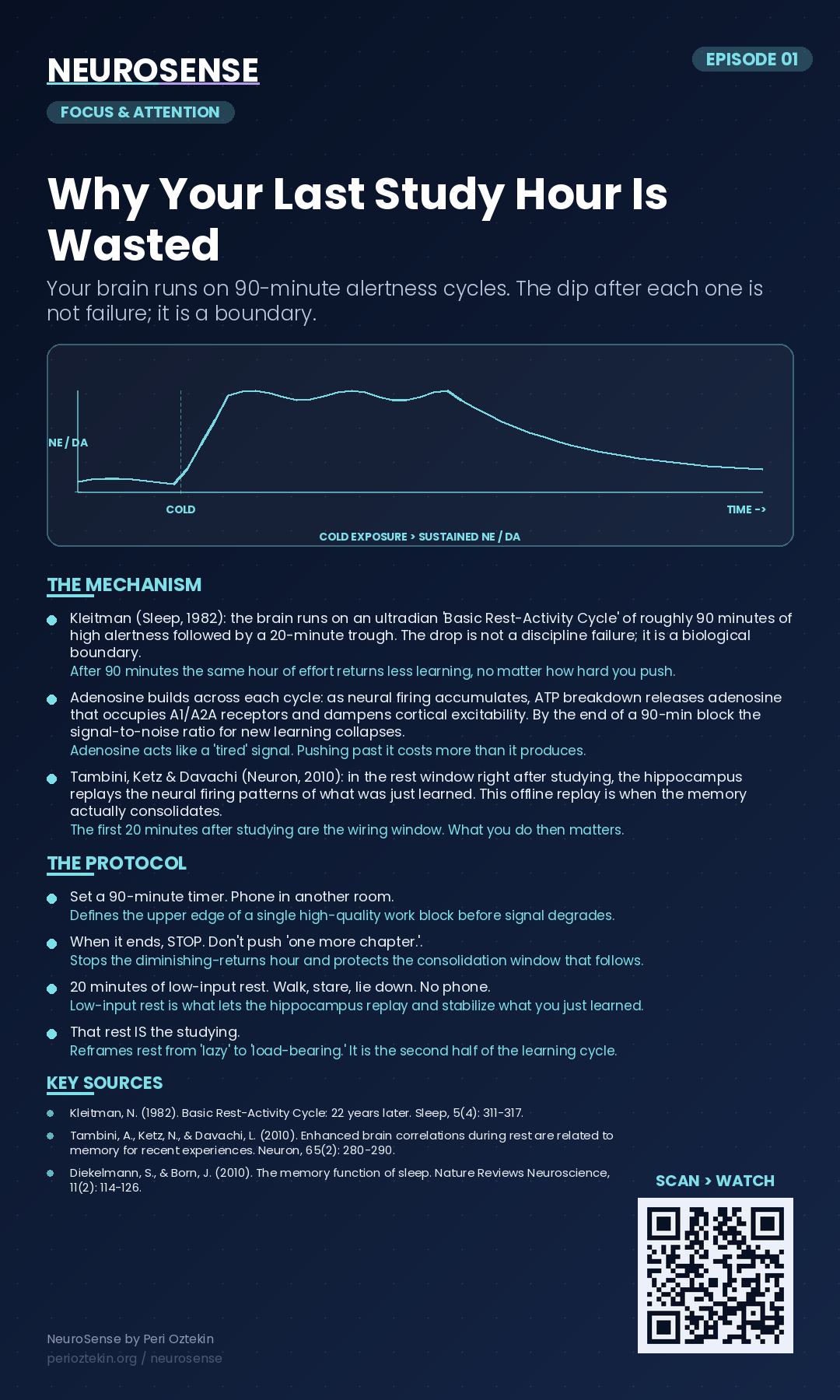
One-page summary
Right-click → Save As to download. Or scan the QR code in the corner to come back here from print.
The science beat (5-sec loop)
Sources
- Kleitman, N. (1982). Basic Rest-Activity Cycle: 22 years later. Sleep, 5(4): 311-317.
- Tambini, A., Ketz, N., & Davachi, L. (2010). Enhanced brain correlations during rest are related to memory for recent experiences. Neuron, 65(2): 280-290.
- Diekelmann, S., & Born, J. (2010). The memory function of sleep. Nature Reviews Neuroscience, 11(2): 114-126.
Educational content only. Not medical advice.
Also on Instagram: @neurosensebrain
← Back to all episodes